Cascade 220 Yarn Substitute: Equal Length Does Not Settle Care or Gauge
For a Cascade 220 yarn substitute, establish whether your pattern means original Cascade 220 or a different 220-family product. Classic 220 Superwash is a candidate to evaluate when its care requirements suit the project, not a verified equivalent. Both official listings give 200 m per 100 g, but their published gauge ranges and care instructions differ. Approve the fabric and care plan before buying each colour's quantity.
Compare the exact family members
Official product pages read on 4 November 2026 provide these references. They are manufacturer specifications, not our physical results.
| Reference | Original Cascade 220 | Classic 220 Superwash |
|---|---|---|
| Fibre | 100% Peruvian Highland wool | 100% superwash wool |
| Mass and nominal length | 100 g; 200 m | 100 g; 200 m |
| Knitting reference per 10 cm width | 18–20 stitches | 20–22 stitches |
| Recommended knitting needle | 4.5–5 mm | 4–4.5 mm |
| Care | Hand wash cold; lay flat to dry | Machine wash cool; tumble dry low |
Sources: Cascade 220 and 220 Superwash. Both publish a metric gauge directly. Neither specification list supplies a row-gauge value, so none is inferred here. The separate Cascade 220 versus Malabrigo Rios comparison covers another candidate; this page focuses on the misleading equal-length family swap.
Decide what the care change must accomplish
Write down why you want a replacement. Replacing an unavailable colour, making a whole new garment and changing the care routine are different tasks. An equal-length candidate can make the purchasing arithmetic simple while leaving the actual task unresolved.
If the finished item will combine original yarn with a replacement, retain both labels. Do not transfer the candidate's machine-care instructions to the original sections. The record should say which yarn is present in which section and what care plan you have established for the complete item. If that plan remains uncertain, keep the mixed project unresolved rather than labelling the entire item machine washable.
For an entirely new project, the original yarn's care instructions are a reference, not automatically the instructions for the replacement. Keep the final candidate label with the finished item. This simple distinction prevents a comparison table from becoming an inaccurate care label.
The overlapping stitch ranges justify investigating the candidate, not accepting it. Compare your pattern's target with your own sample, recording the actual tool. A match at the edge of a published range still needs a fabric decision. If the pattern shapes by row counts, record row gauge too; the missing manufacturer row figure cannot answer that question for you.
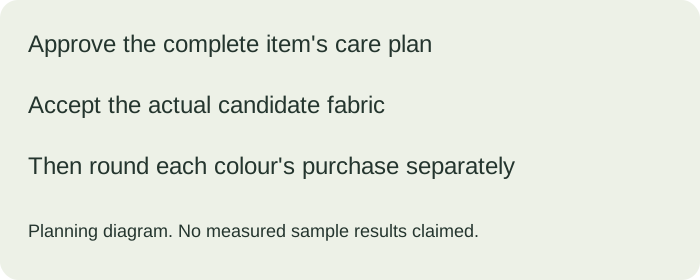
Equal ball lengths still need separate colour rounding
Consider a hypothetical design allocating 250 g of original Cascade 220 to a main colour and 25 g to a contrast. Suppose the candidate has been accepted and the required nominal lengths remain appropriate. These are demonstration assumptions, not measured use or a real pattern recommendation.
| Hypothetical role | Original reference length | Candidate whole hanks, zero extra metres |
|---|---|---|
| Main | 250 ÷ 100 × 200 = 500 m | ceil(500 ÷ 200) = 3 |
| Contrast | 25 ÷ 100 × 200 = 50 m | ceil(50 ÷ 200) = 1 |
The result is four hanks across the two colours. Pooling 550 m gives ceil(550 ÷ 200) = 3, which loses the separate contrast allocation. Equal metres per hank do not make colours interchangeable.
Formula for one colour: whole candidate hanks = ceil((required metres + explicit extra metres) ÷ candidate metres per hank). Zero extra metres is a demonstration setting, not a suggested allowance. Record any sample and project allowance explicitly before rounding again. A change in fabric or dimensions may require revising the input length, not merely the denominator.
Retain the exact product name and shade code on every row. The shared number in the family name is not a specification for every related product. If your supplier offers a different family member, verify its own label before carrying over these values. Leave an unknown row blank instead of guessing a length from the name.
Download the per-colour purchasing CSV. Example rows are marked HYPOTHETICAL, followed by blank project rows. This is a record sheet, not an automatically recalculating spreadsheet.
Paired swatch status: not tested
No original Cascade 220/220 Superwash physical pair has been tested for this page. Download the blank paired record. Its measured-result fields are empty.
Keep the maker, stitch and measuring method consistent and record actual tools, care and adjustments. Measure before care and after complete drying. If the two yarns receive different treatments, document that difference; it is part of the comparison. Separate manufacturer reference counts from measured stitch and row results. Record a mixed-yarn junction when that is the intended use, because two acceptable separate squares do not establish an acceptable joined section.
Questions before choosing
Are the same grams enough?
The listed nominal lengths match per 100 g, but no measured consumption comparison has been performed. That equality does not guarantee the finished project.
Can I fill in a row gauge from the stitch range?
No. They are different measurements. Record your own row result when the pattern needs it.
Does this cover every 220 Superwash variant?
No. This page compares the exact two linked products. Use the main substitution guide to evaluate another candidate from its own specifications.