Stylecraft Special DK Substitute: Replace a Missing Shade Without Losing the Palette
For a Stylecraft Special DK substitute, decide whether you need one missing shade or a complete new palette. Keep the pattern's fabric requirements fixed, check the proposed shade in context, then calculate the remaining metres for each colour. Caron Simply Soft is a candidate to evaluate, not a verified drop-in replacement; its manufacturer reference gauge differs. A matching colour name cannot establish a match.
Keep the reference and the candidate separate
Official pages read on 1 November 2026 supply these figures. They are manufacturer references, not our sample measurements.
| Specification | Stylecraft Special DK | Caron Simply Soft |
|---|---|---|
| Ball | 100 g; 295 m | 170 g; 288 m |
| Composition | 100% premium acrylic | See exact product label |
| Knitting reference per 10 × 10 cm | 22 stitches × 30 rows | 18 stitches × 24 rows |
| Listed knitting needle | 4 mm | 5 mm |
Sources: Stylecraft Special DK and Caron Simply Soft. Both publish metric gauge directly. For the detailed two-yarn comparison, use the existing Special DK versus Simply Soft page. This page handles the different problem of completing a palette with usable stash.
One unavailable shade is a different decision
A historical community question describes a Persian Tiles project missing Special DK Sage, with screen colour insufficient for the maker to judge a replacement. This is evidence of a real matching problem, not current stock information or proof of any suggested equivalent.
Separate three cases on your shopping record: a full palette not yet started, a missing shade before that shade is worked, and a replacement joining an already-worked section. These cases have different acceptance conditions. A coordinated but different palette may be acceptable in the first; a visible junction may matter most in the last. Do not quietly turn a request for an invisible repair into a recommendation to redesign the project.
Keep the original shade code and proposed candidate code in separate columns. Record whether a comparison was made with physical yarn, a supplier sample or only an image. An image-only choice remains provisional. Colour names shared by brands do not supply a measurement of similarity.
If you are keeping other original colours, evaluate the candidate beside those colours rather than alone. A candidate can seem plausible in isolation yet fail the intended contrast. That is a project decision to record, not a claim that a named substitute has been tested here. If the visual requirement fails, stop before quantity calculations turn a rejected choice into a shopping list.
Subtract usable stash before rounding the purchase
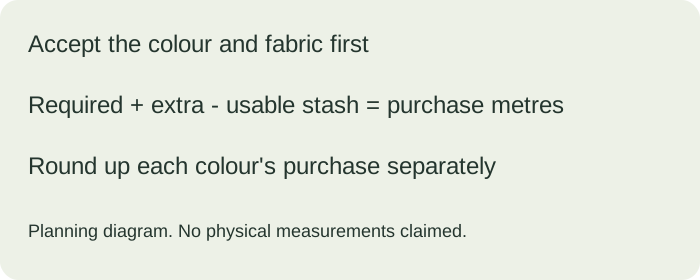
The worksheet treats each colour as its own ledger. In a hypothetical scenario, the plan allocates 150 g of Special DK to a main colour and 20 g to a contrast. Assume an accepted candidate supplies 288 m per ball, and you already have 200 usable metres of that exact candidate main colour. The contrast has no usable stash. These are demonstration assumptions, not an actual pattern or measured consumption.
| Hypothetical role | Reference metres | Usable candidate stash | Metres still to buy | Whole candidate balls |
|---|---|---|---|---|
| Main | 150 ÷ 100 × 295 = 442.5 | 200 | 242.5 | ceil(242.5 ÷ 288) = 1 |
| Contrast | 20 ÷ 100 × 295 = 59 | 0 | 59 | ceil(59 ÷ 288) = 1 |
Formula for each colour: purchase metres = max(0, required metres + explicit extra metres − usable candidate stash metres). Purchase balls = ceil(purchase metres ÷ candidate metres per ball). The example has zero extra metres; that is a demonstration setting, not a recommended allowance.
Two mistakes are easy to expose with this record. Rounding the main requirement before deducting its stash can overstate the new purchase. Pooling the two colours after the deduction can understate it: 301.5 pooled metres rounds to two balls, but the distribution still needs to be checked even when the total happens to agree. A pooled total is not a colour allocation.
Only deduct stash that is suitable for that row. Unrelated leftovers, unusable yarn and material reserved for another project do not reduce its order. If your stash figure is only a weight, establish its own label's metres per gram before converting; do not apply Special DK's factor to a different yarn. Record uncertainty rather than converting an unknown label into a precise length.
Download the per-colour purchasing CSV. It contains clearly labelled hypothetical examples and blank project rows. It is a record sheet, not an automatically recalculating spreadsheet. All length planning remains conditional on the candidate fabric being accepted and the required length remaining appropriate.
Paired swatch status: not tested
No Special DK/Simply Soft paired samples have been made for this page. Download the blank paired record. Measured-result fields remain empty.
Use the same maker, stitch and measuring method for the comparison, recording actual tools and every adjustment. Measure before care and after complete drying, documenting the treatment. Keep manufacturer references out of measured-result fields. Where the project joins existing fabric, test that junction too. A separate square cannot establish an invisible join.
Questions before completing the palette
Should I replace every colour because one is missing?
That is a design choice, not a necessary consequence. Record which colours must remain and evaluate the missing shade against them first.
Does the worksheet establish a colour match?
No. It records a decision and its evidence; it does not measure colour or guarantee matching dye lots.
Does unused stash make the replacement suitable?
No. Availability and quantity are separate from fabric acceptance. Use the main substitution guide for that decision before counting a leftover as usable.