YarnArt Jeans Substitute: Compare the Fabric, Then Buy by Colour
For a YarnArt Jeans substitute, first match the fabric your pattern needs, then recalculate metres for each colour. Scheepjes Stone Washed and Catona are candidates to investigate, not exact replacements: their fibre blends and metres per ball differ. Make a project-stitch swatch before buying the full colour set. For a doll with separate clothing, test the body and clothing together before committing.
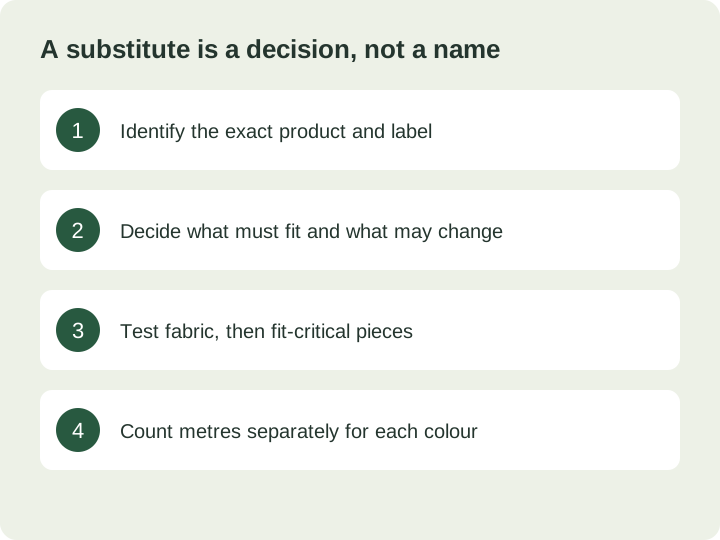
Start with the exact Jeans label
Our saved official YarnArt Jeans product record, retrieved on 24 October 2026, lists 55% cotton and 45% acrylic, 50 g and 160 m. Its original product link returned an error during our 26 October recheck, so these are dated reference specifications. Check your physical label before using them. A matching word in another manufacturer's yarn name is not a matching specification.
The two comparison products below were checked on their manufacturer's website on 26 October 2026. Needle sizes describe the manufacturer's recommendation, not a guarantee that your crochet or knitting will match a pattern.
| Yarn | Fibre | Ball | Length | Manufacturer needle recommendation |
|---|---|---|---|---|
| YarnArt Jeans, dated reference | 55% cotton, 45% acrylic | 50 g | 160 m | Check current label |
| Scheepjes Stone Washed | 78% cotton, 22% acrylic | 50 g | 130 m | 3–3.5 mm |
| Scheepjes Catona 50 g | 100% mercerised cotton | 50 g | 125 m | 2.5–3.5 mm |
Stone Washed has a manufacturer-described two-tone appearance; Catona is a mercerised cotton yarn. Those are real differences to inspect if the pattern's colour blocks or surface finish matter. Neither a shared cotton component nor a compatible-looking needle range proves equivalence.
Choose which compromise you can actually accept
For this decision, put three small notes beside the pattern: must fit, must look alike, and may change. Sort the project requirements into those notes before sorting yarn brands. That turns a vague search for the best substitute into a test you can finish.
For a decorative doll, an overall change of size may be acceptable while a change of facial proportions is not. For a doll with a separately worked jacket, the important constraint may instead be whether the jacket still closes over the body. For a garment, a familiar colour may be less useful than a fabric that reaches the intended dimensions after its planned care routine. These are decision scenarios, not claims about how the listed yarns performed in a test.
Then choose a candidate for a stated reason. Investigate Stone Washed if you want to retain a cotton-acrylic blend and its appearance suits the design. Investigate Catona if you deliberately want to evaluate an all-cotton option. Reject either candidate if your sample does not satisfy the requirements you put under must fit or must look alike. Do not keep changing the tool size simply to force a number while accepting fabric you dislike.
A useful sample is the smallest piece that exposes the expensive mistake. A flat square can check stitches and handle. It cannot prove that a small curved limb, a narrow sleeve, or an attachment will fit. After the square, work the relevant shape or a short trial section if that is where fit depends on the yarn. Keep that sample rather than unravelling your only evidence before you order.
If the design uses several colours, try adjacent shades together. Checking the body yarn alone leaves you unable to judge a face detail or a separate garment in the replacement range. A yarn substitution is also a colour-plan substitution when the original palette cannot be recreated. Write down which difference you accepted so you do not mistake an intentional compromise for a later error.
Length changes even when ball weight stays the same
All three reference balls weigh 50 g, but their stated lengths are different. The calculation for any candidate is:
Minimum balls = round up(required metres ÷ metres per candidate ball).
Use the pattern's required length if it gives one. If it gives a number of original balls, multiplying that count by the original ball length produces a purchasing reference, not a measurement of how much the finished object actually uses. Swatching, changed fabric and leftover yarn can affect the real requirement.
A worked two-colour buying plan
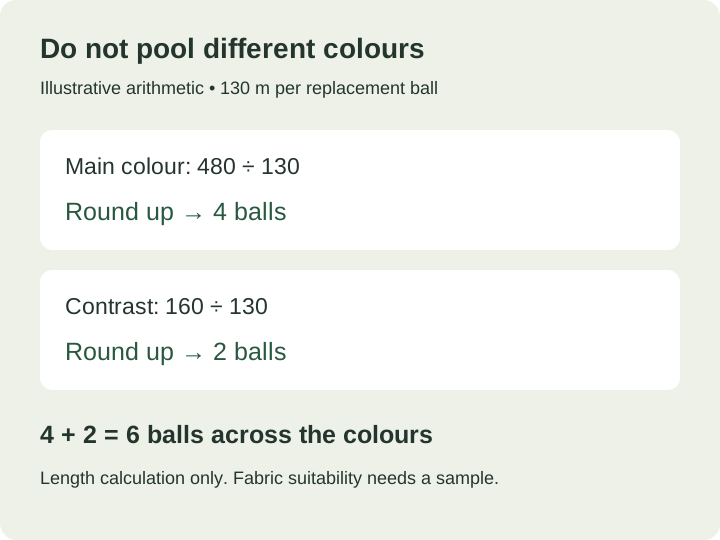
Suppose a pattern asks you to buy three 160 m balls for its main colour and one for its contrast colour. This is an invented planning example, explicitly not a pattern we have tested. The original lengths are:
- Main: 3 × 160 = 480 m.
- Contrast: 1 × 160 = 160 m.
- Combined reference: 480 + 160 = 640 m.
With a 130 m replacement, calculate ceil(480 ÷ 130) = 4 main-colour balls and ceil(160 ÷ 130) = 2 contrast-colour balls. That means six balls across the two colours. The inputs are the hypothetical pattern counts and the official Stone Washed length; the outputs are arithmetic, not a recommendation that Stone Washed will achieve the same gauge.
Why not divide the total? Because ceil(640 ÷ 130) = 5 pools yarn from colours you cannot interchange. You cannot finish a contrast-colour sleeve using spare main-colour yarn while keeping the intended palette. The total-only calculation hides a purchasing problem even though the arithmetic itself is correct.
With a 125 m replacement, the same method gives ceil(480 ÷ 125) = 4 main-colour balls and ceil(160 ÷ 125) = 2 contrast-colour balls. Here the counts happen to agree with the 130 m scenario. The remaining lengths do not: four 130 m balls provide 520 m, while four 125 m balls provide 500 m. Equal rounded counts do not make two yarns interchangeable.
Treat all of those results as minimum counts for the reference length only. They include no allowance for your sample or altered yarn consumption. Record those needs separately from the pattern reference. If the sample uses yarn that will not go into the object, it must come from somewhere; quietly treating it as free turns an otherwise careful worksheet into another shortage.
A colour ledger you can use
Make one row for each shade, even for a small amount. In the required-metres column, distinguish a pattern's measured requirement from a full-ball purchasing reference. In a separate notes column, record any sample yarn, uncertainty or deliberately accepted colour change. Use the downloadable blank colour worksheet and keep your ball labels with it.
| Colour role | Reference metres | Candidate m/ball | Minimum reference balls |
|---|---|---|---|
| Main, hypothetical example | 480 | 130 | 4 |
| Contrast, hypothetical example | 160 | 130 | 2 |
This worksheet solves a quantity question. It does not decide whether the yarn is suitable. Keep the fabric decision and the purchasing calculation as two separate approvals: first accept the sample, then fill the order. If either remains unresolved, you have not yet chosen a substitute.
Questions before you order
Is Catona an exact substitute for YarnArt Jeans?
No exact match is established here. The reference compositions differ, as do the listed metres per ball. Catona is a candidate for a deliberate all-cotton change, subject to your own project sample.
Does Stone Washed use the same number of balls?
Do not assume that. Its official ball length is 130 m, compared with the dated Jeans reference of 160 m. Recalculate each shade and then account for the sample and any changed consumption. This page does not establish an exact conversion for every pattern.
Can I keep the original hook?
Use the pattern's tool as a starting point if appropriate, then evaluate your sample. A manufacturer's knitting needle recommendation does not determine the crochet hook that will make your particular project work. We have not measured a replacement hook size for these pairings.
What should I check for a doll with clothes?
Make the fit-critical pieces as a pair: the part of the body covered by the clothing and the corresponding clothing section. Decide whether they work together before you buy every colour. This is an editorial test plan, not a report of a doll we made.
Sources and scope
- YarnArt Jeans original official product reference: saved on 24 October 2026; direct recheck on 26 October returned an error. Confirm against the label in hand.
- Scheepjes Stone Washed: official specifications checked 26 October 2026.
- Scheepjes Catona 50 g: official specifications checked 26 October 2026.
The buying examples and decision worksheet are our original analysis. They are not hands-on yarn tests, universal equivalence claims or statements about live price and stock. For other yarn families, use the official-specification comparison chart and the main substitution guide.