Bernat Softee Chunky Yarn Substitute: Count Each Shade's Actual Metres
For a Bernat Softee Chunky yarn substitute, Lion Brand Hometown is a candidate to swatch, not a verified equivalent. Compare your pattern's gauge first, then buy by the metres on each chosen shade's label. Hometown's official listing gives different lengths for its standard and print skeins, so applying one ball conversion to the entire palette can underbuy a colour.
Compare the official references
Product pages read on 29 October 2026. These are manufacturer specifications, not results from samples made for this article.
| Reference | Bernat Softee Chunky | Lion Brand Hometown |
|---|---|---|
| Listed ball mass | 100 g | 142 g; 113 g in prints |
| Listed nominal length | 99 m | 74 m; 59 m in prints |
| Fibre detail | 100% acrylic | Solids, multis, neons and twists: 100% acrylic; tweeds: 94% acrylic, 6% rayon |
| Recommended knitting needle | 8 mm | 9 mm |
| Knitting reference per 10 × 10 cm | 11 stitches × 14 rows | 8.86 stitches × 11.81 rows, converted from 4 in |
Sources: Bernat Softee Chunky, 100 g and Lion Brand Hometown. Hometown publishes 9 stitches × 12 rows over 4 inches. Conversion uses 4 in = 10.16 cm: 9 × 10 ÷ 10.16 = 8.86 and 12 × 10 ÷ 10.16 = 11.81, rounded for display. Bernat supplies its metric reference directly. Converting a label reference is not measuring a new swatch.
Separate the colour choice from the label category
Make a shopping record with one row per actual shade. Record the product's colour code, stated length, fibre and ball mass on that row. A common brand name can stay the same while one of those inputs changes. Do not decide that a shade is a print solely because it looks multicoloured in a photograph; use its actual label or ask the supplier which specification applies.
There are two independent checks here. The fibre check asks whether the chosen shade still fits your material requirements. The length check asks how many balls supply the assumed metres. Passing one does not answer the other. If an all-acrylic replacement is part of the brief, the official tweed composition needs a separate decision. Do not hide it inside a generic acrylic description.
Treat the recommended tools as references for selecting a trial. Their difference and the different listed gauges give no basis for promising identical fabric. For a fitted project, keep the pattern's target dimensions and gauge beside the sample. For a project where size may change, write that permission down rather than discovering it after purchasing.
Why a smaller contrast skein can change the order
Consider a hypothetical Softee Chunky allocation of 200 g for a main shade and 70 g for a contrast. These are demonstration inputs, not a real pattern or measured consumption. The reference yarn supplies 99 m per 100 g:
reference metres = allocated grams ÷ 100 × 99
candidate balls for each shade = ceil((reference metres + chosen extra metres) ÷ that shade's metres per ball)
| Hypothetical shade | Reference metres | Candidate label assumed for this example | Whole balls, zero extra metres |
|---|---|---|---|
| Main: 200 g | 200 ÷ 100 × 99 = 198 m | Hometown, 74 m | ceil(198 ÷ 74) = 3 |
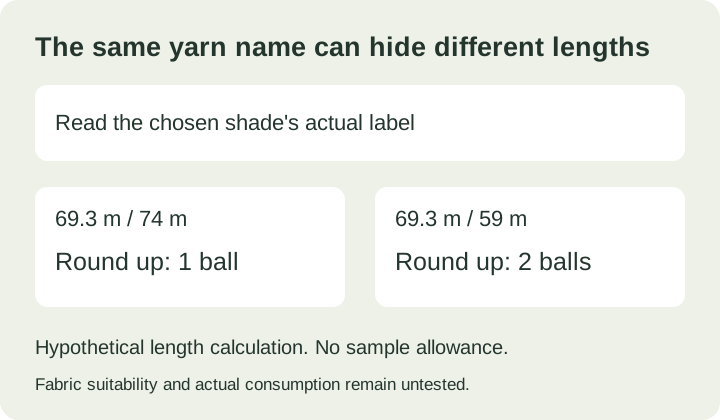
| Contrast: 70 g | 70 ÷ 100 × 99 = 69.3 m | Hometown print, 59 m | ceil(69.3 ÷ 59) = 2 |
The contrast is where a blanket conversion fails. Dividing its 69.3 m by an assumed 74 m would suggest one ball. Using the print length of 59 m gives two. This is not evidence that a particular shade is available or suitable; it shows why the correct label must feed each row of the calculation.
Keep the two colours separate even after recording the correct lengths. Their leftovers cannot supply one another without changing the design. Add sample yarn and any project-specific extra metres explicitly; the example's zero allowance is a calculation setting, not buying advice. If the accepted fabric changes consumption, revise the required metres as well as the ball length.
Download the per-shade purchasing CSV. The example rows are marked HYPOTHETICAL EXAMPLE; blank rows are for your actual labels. This is a record sheet with visible inputs, not an automatically recalculating spreadsheet.
A paired record without invented results
Paired swatch status: not tested. We have not made Softee Chunky/Hometown samples. Download the blank paired record. Its measured fields are empty.
For a comparison, keep the maker, stitch and measuring method consistent. Record the actual tool and every adjustment. Measure before care and after complete drying, using the care appropriate to each yarn and noting any treatment difference. Record stitch and row density separately; do not fill those fields with the manufacturer's references.
If the project combines original stash yarn with a replacement shade, evaluate the joined section too. A passing separate square does not demonstrate a successful mixed-yarn junction. Save the rejected trial and the accepted trial with their labels so the order refers to the material you actually evaluated.
Before ordering
Does the heavier Hometown ball replace more Softee Chunky?
Not by these nominal lengths. The listed standard Hometown ball is heavier but supplies fewer metres. Ball mass alone cannot determine the quantity.
Is this a replacement for Bernat Blanket?
This article concerns acrylic Softee Chunky, not the polyester Blanket family. Use the separate Bernat Blanket guide to identify that product before using its figures.
Must every Hometown shade use the same calculation?
Use the same formula, but copy each shade's actual length into its own denominator. If the supplier cannot establish the correct label category, leave that row unresolved instead of guessing.
Software checks confirm the example arithmetic only. They establish no measured fit, softness, wear or consumption. The main substitution guide covers the wider decision process.