Premier Parfait Chunky Yarn Substitute: Plan the Palette Before Buying
For a Premier Parfait Chunky yarn substitute, Hobbii Honey Bunny is a candidate to sample: both official listings give 100% polyester and 120 m per 100 g. That length match makes the shopping arithmetic simple, but does not prove matching crochet fabric. Check the exact colour range, your pattern's finished gauge and the fit-critical parts before ordering every shade. The downloadable worksheet below keeps those decisions together.
Check the exact product, not just the family name
The following manufacturer references were read on 27 October 2026. They describe the regular products linked here, not every yarn sharing the Parfait or Honey Bunny name.
| Reference | Premier Parfait Chunky | Hobbii Honey Bunny |
|---|---|---|
| Fibre | 100% polyester | 100% polyester |
| Ball mass and nominal length | 100 g; 120 m | 100 g; 120 m |
| Listed crochet hook | 8 mm | 7 mm |
| Crochet gauge per 10 × 10 cm | 8.86 single crochet × 8.86 rows, converted from 4 in | 8 stitches × 9 rows |
Sources: Premier Parfait Chunky and Hobbii Honey Bunny, official metric listing. Premier publishes 9 single crochet × 9 rows over 4 inches. The conversion is 9 × 10 ÷ 10.16 = 8.8583…, displayed as 8.86; 4 inches equals 10.16 cm. Hobbii publishes its metric reference directly. These are label references from different manufacturers, not a controlled paired test.
Hobbii also notes a product refresh while older stock is phased out. Record the actual product label and lot rather than assuming an older recommendation describes the stock offered today. We have not tested the difference between those stocks.
Decide whether the unavailable colour forces a whole-project change
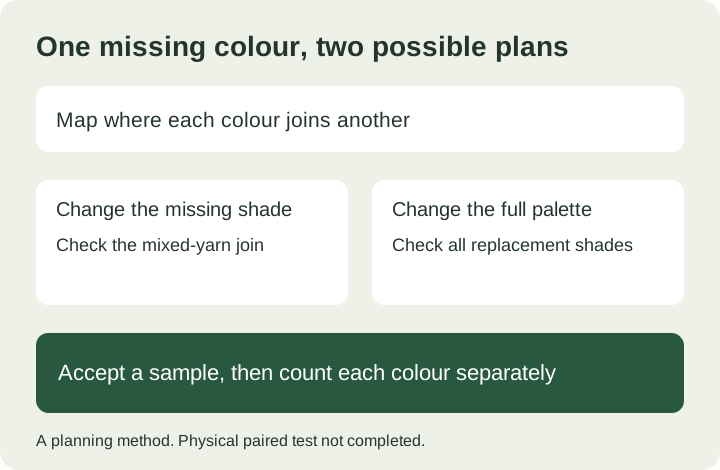
Start with a palette map, not a cart. Give each colour a role: main fabric, adjoining contrast, isolated detail or separately fitted part. Then mark where two colours touch. This simple map shows where substituting only the missing colour deserves a joined sample rather than a separate square.
If the main body and its contrasting panel must meet along the same seam, try that junction in the intended stitches. A replacement that looks acceptable by itself may still fail your own acceptance condition at the join. If the missing shade is an isolated decoration, decide whether its dimensions and appearance can deliberately differ. Neither outcome is established by a matching fibre percentage.
There are two purchasing plans to compare. One changes only the missing shade; the other changes the full palette. The first may preserve usable yarn you already own, but leaves a mixed-yarn join to check. The second needs a new colour map and quantities for every shade, even if it removes that particular mixed-yarn join. Write which plan you chose before calculating balls. Do not let a shop's available shade silently choose the project design for you.
For an amigurumi with removable clothing, keep body and clothing decisions linked. A flat gauge check does not show whether a sleeve fits over the limb. Include a fit-critical trial section if that is the expensive failure you need to avoid. This is a proposed evaluation method; no toy or garment has been made for this page.
A per-colour order example with equal nominal lengths
Suppose a hypothetical project allocates 160 g of Parfait Chunky to a main colour, 35 g to a contrast and 10 g to a detail. These are invented demonstration inputs, not a real pattern's requirements or measured consumption. With both listed yarns at 120 m per 100 g:
required metres = original grams ÷ 100 × 120
whole replacement balls for each colour = ceil((required metres + chosen extra metres) ÷ 120)
| Hypothetical allocation | Reference metres | Honey Bunny balls, with zero extra metres |
|---|---|---|
| Main: 160 g | 160 ÷ 100 × 120 = 192 m | ceil(192 ÷ 120) = 2 |
| Contrast: 35 g | 35 ÷ 100 × 120 = 42 m | ceil(42 ÷ 120) = 1 |
| Detail: 10 g | 10 ÷ 100 × 120 = 12 m | ceil(12 ÷ 120) = 1 |
The illustrative order is four balls across three colours. Pooling 246 m would give three balls, but would discard the colour allocation. Equal metres per gram do not mean you can share a leftover between colours without changing the design.
The example includes no allowance. Add testing yarn and any project-specific extra length explicitly, then round each colour again. If sampling leads you to change the fabric or pattern, revisit the assumed required metres rather than treating a mathematically correct order as a consumption guarantee.
Download the per-colour purchasing worksheet. It contains the labelled hypothetical example and blank project rows. The CSV does not recalculate automatically. Use the printed formulas, and retain the actual source label for the replacement's metres per ball.
Keep the paired sample record honest
Paired swatch status: not tested. We have no measured Parfait Chunky/Honey Bunny samples. Download the blank paired record; its measurement fields are intentionally empty.
Use the same person, project stitch, measuring method and tool setup for an initial comparison. Record tool changes if you later adjust for the pattern. Follow the applicable care labels and record any differences in treatment. Measure before care and again when fully dry; keep stitch density, row density and overall dimensions as separate observations. Do not enter manufacturer reference values as if you had measured them.
For a mixed-colour trial, record which yarn is on each side of the junction and whether the joined piece passes your stated requirement. A useful result includes the rejected trial as well as the accepted one. One passing sample supports that particular project decision; it does not prove universal equivalence, long-term durability or toy safety.
Questions to settle before checkout
Can I keep my Parfait Chunky pattern's hook?
You can evaluate it in a sample; neither label establishes the answer for your own pattern. The official recommended hooks here differ. Do not replace a pattern-specific fit check with a retailer's recommended tool size.
Is a matching colour name enough?
No shade match has been established here. Record both colour codes, compare them in the project palette and check current availability. A colour name is a label, not evidence that adjacent fabrics look alike.
What about Bernat Blanket instead?
Use the separate Bernat Blanket and Parfait Chunky comparison for those specific label differences. This page's equal-length example concerns Honey Bunny, so its ball calculation must not be copied over to Bernat Blanket.
The purchasing examples were checked in software. They test arithmetic only; actual fabric, fit and consumption remain untested. For the broader process, see the main substitution guide.