Bernat Blanket Yarn Substitute: Check the Variant Before Counting Balls
For a Bernat Blanket yarn substitute, identify the exact Blanket product first, compare the candidate against your pattern's gauge, then calculate metres for each colour. Premier Parfait Chunky is a chenille candidate to test, not a confirmed equivalent. Bernat Blanket Big is a different jumbo product, so a matching brand name and 300 g ball do not make it a replacement for regular Blanket.
The same 300 g can describe very different yarns
Manufacturer product pages checked on 28 October 2026 list the following regular Blanket and Blanket Big references. The metric gauge figures are published directly by Yarnspirations; they are not our swatch measurements.
| Official reference | Bernat Blanket | Bernat Blanket Big |
|---|---|---|
| Ball mass | 300 g | 300 g |
| Nominal length | 201 m | 29 m |
| Fibre | 100% polyester | 100% polyester |
| Weight category | #6 Super Bulky | #7 Jumbo |
| Crochet reference per 10 × 10 cm | 7 single crochet × 8 rows | 2 single crochet × 2 rows |
| Listed crochet hook | 8 mm | 25 mm |
Sources: Bernat Blanket, official 300 g product and Bernat Blanket Big, official 300 g product. Those are separate products. This comparison does not establish which one your pattern requires; read its exact materials list.
Use the label as an identity check
Before searching for a substitute, copy the original product name, ball mass, metres per ball, colour code and gauge from the pattern and label. If the pattern photograph and the named yarn seem inconsistent, resolve that discrepancy before buying. A large-looking ball is not a measurement of strand thickness.
Two checks answer different questions. The metres-per-ball check tells you how much nominal length a ball supplies. The gauge check tells you whether the manufacturer's reference is even in the region you expected. Neither proves the fabric you will make. In the table above, equal mass disguises both a large length difference and a different gauge category; that is a reason to reject an automatic name-based swap, not a reason to divide metres and buy Blanket Big for an unchanged regular-Blanket pattern.
Keep the family-name check on the shopping record. If a seller's title says only Blanket, compare the photographed label with the product you recorded. Leave the decision unresolved if the identity cannot be established. Guessing which variant is pictured makes every later calculation look more certain than its inputs.
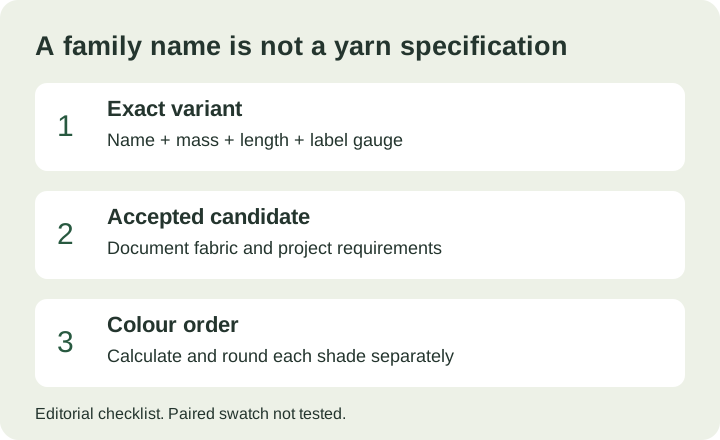
Consider a different-brand candidate without promising equivalence
Premier's Parfait Chunky product page, read on 28 October 2026, lists 100% polyester and 120 m per 100 g. The existing Blanket-versus-Parfait comparison explains their differing published gauges. Use it to shortlist a trial, not to skip that trial.
Make the acceptance condition specific to the project. A replacement for a rectangular blanket may need an acceptable fabric and revised dimensions; a shaped piece may require the original finished dimensions to remain intact. Decide what may change before adjusting tools. A sample that reaches a stitch count but fails your own handle or opacity requirement has not passed.
Paired swatch status: not tested. No physical Blanket/Parfait samples or consumption results are available here. Download the blank paired record. Record the same maker, stitch and measurement method, actual tools, care used, and before/after-care dimensions once completely dry. Keep any changed condition visible. Do not enter manufacturer gauge figures into measured-result fields.
Turn the regular Blanket allocation into a colour-specific order
This is a hypothetical length-only example, not a real pattern or measured yarn use. Suppose a regular Blanket project allocates 450 g to its main colour, 90 g to a contrast and 20 g to a detail. Using its nominal 201 m per 300 g and Parfait Chunky's 120 m per 100 g:
reference metres = original grams ÷ 300 × 201
candidate balls for one colour = ceil((reference metres + chosen extra metres) ÷ 120)
| Hypothetical colour | Reference length | Parfait balls with zero extra metres |
|---|---|---|
| Main: 450 g Blanket | 450 ÷ 300 × 201 = 301.5 m | ceil(301.5 ÷ 120) = 3 |
| Contrast: 90 g Blanket | 90 ÷ 300 × 201 = 60.3 m | ceil(60.3 ÷ 120) = 1 |
| Detail: 20 g Blanket | 20 ÷ 300 × 201 = 13.4 m | ceil(13.4 ÷ 120) = 1 |
The example needs five balls across those colours. Pooling the reference lengths gives 375.2 m and rounds to four balls, losing the colour allocation. This check only compares nominal supplied length. Changed gauge, stitch construction or dimensions may change actual consumption; the example does not guarantee that five balls finish an adaptation.
The displayed zero extra metres is a demonstration setting. Add your testing and project-specific allowance explicitly, then round each colour separately again. Record what you already own by colour rather than deducting an unrelated leftover from the total.
Download the colour purchasing worksheet. It includes clearly marked hypothetical rows and blank project rows. It is a record sheet, not an automatically recalculating spreadsheet. Enter the actual variant and replacement label before applying the formulas.
Questions before placing an order
Can I buy the same grams of a replacement?
Not from these figures alone. The listed yarns supply different metres per gram. Length is the purchasing starting point after the candidate is accepted; mass alone does not preserve length or fabric.
Does a matching shade name establish a match?
No colour match has been tested here. Keep original and candidate colour codes in separate fields and evaluate them in the intended palette. A name shared by two products is not a measured colour comparison.
Can this worksheet finish an existing project for me?
It can keep the arithmetic and remaining colour allocations explicit. It cannot establish that a new yarn will join invisibly to an already-worked section. Evaluate that junction before treating a replacement order as a solution.
The arithmetic was checked in software. That establishes reproducible example calculations, not physical yarn performance. Use the general substitution guide when deciding which project requirements must stay fixed.