Lion Brand Wool-Ease Thick and Quick Substitute: Check the Pack Before the Yarn
For a Lion Brand Wool-Ease Thick and Quick substitute, first establish the exact pack and colour category used by the pattern. Hometown is a candidate when a change of fibre is acceptable, not a tested equivalent. Compare the required fabric, then calculate each colour's metres separately. Matching published gauge does not establish matching performance.
Start with the exact product
Official product pages read on 31 October 2026 publish these references. These are manufacturer figures, not our measurements.
| Reference | Wool-Ease Thick & Quick | Hometown |
|---|---|---|
| Metres per ball | 97 standard; 80 prints/stripes; 84 metallic | 74 standard; 59 prints |
| Grams per ball | 170 standard; 140 prints/stripes/metallic | 142 standard; 113 prints |
| Knitting reference per 10 × 10 cm | 8.86 stitches × 11.81 rows, converted from 4 in | 8.86 stitches × 11.81 rows, converted from 4 in |
| Listed knitting needle | 9 mm | 9 mm |
Sources: Wool-Ease Thick & Quick and Hometown. Both list 9 stitches × 12 rows over 4 inches. Conversion: 4 in = 10.16 cm; multiply each count by 10 ÷ 10.16 and round to two decimals. Wool-Ease composition varies by shade; most colours list 80% acrylic and 20% wool. Hometown solids, multis, neons and twists list 100% acrylic; tweeds list 94% acrylic and 6% rayon.
Resolve a pack-size mismatch before changing brands
The Wool-Ease product page contains a customer report of running short on an Urban Grid Afghan. The manufacturer's response identifies the original yarn as a discontinued Bonus Bundle with twice the regular skein's yardage. This is a documented pack mismatch, not a controlled consumption test or proof that every pattern has incorrect quantities.
That distinction changes the first question to ask. If the pattern specifies a larger pack of the same yarn, replacing its ball count with the regular pack count is already a substitution error, even before considering another brand. Copy the original pack description beside every colour allocation. A familiar product name is insufficient.
If the old pack length is unavailable, leave its required metres unresolved. Do not quietly substitute today's regular length. Find the exact pattern edition or obtain clarification before making a purchase calculation. Our worksheet has a separate original-pack field so this uncertainty cannot disappear inside a single total.
Keep this identity check separate from sample acceptance. Correcting the pack quantity may solve a length shortfall without solving a fabric problem; changing brands may introduce a new fabric decision without fixing an unidentified original allocation. Work out which problem you actually have.
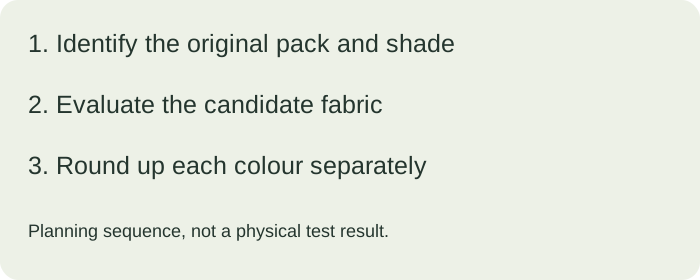
A colour-by-colour order, with visible assumptions
Consider a hypothetical pattern requiring two standard regular Wool-Ease balls for its main colour and one print ball for a contrast. The allocation represents nominal supplied length, not measured consumption. Suppose the proposed Hometown main shade has a 74 m label and the contrast print has a 59 m label. No extra allowance is included in this demonstration.
| Hypothetical allocation | Reference metres | Candidate balls |
|---|---|---|
| Main: two regular standard balls | 2 × 97 = 194 m | ceil(194 ÷ 74) = 3 |
| Contrast: one regular print ball | 1 × 80 = 80 m | ceil(80 ÷ 59) = 2 |
The result is five balls across two colours. Pooling 274 m and dividing by 74 produces four, but erases both the contrast's different ball length and its separate colour requirement. That pooled answer cannot describe the stated order.
Use this general formula for each row: whole candidate balls = ceil((required metres + explicit extra metres) ÷ candidate metres per ball). Identify how required metres were obtained. Pattern-specified length, full original balls and weighed leftovers are different inputs; do not label them all measured use.
Keep unverified shades out of the final shopping total. If you cannot identify whether a selected colour uses the standard or print specification, ask the supplier for its label rather than choosing the denominator that produces the cheaper order. Add any sample and project allowance explicitly. A length calculation does not guarantee completion after changes in gauge or dimensions.
Download the per-colour purchasing CSV. Example rows are marked HYPOTHETICAL. Blank rows capture your original pack, shade and candidate label. This is a record sheet, not an automatically recalculating spreadsheet.
Paired swatch status: not tested
No Wool-Ease/Hometown physical samples have been made for this page. Download the blank paired record; measured fields remain empty. Keep the maker, stitch and measuring method consistent, recording actual tools and any adjustments. Compare before care and after complete drying, with each treatment recorded. Never paste the manufacturer's gauge into a measured-result field.
The shared reference gauge makes Hometown worth evaluating for this particular decision; it does not answer whether its fabric meets your project requirements. Write those requirements before sampling: required dimensions, permissible material changes and the intended use. If retaining wool is essential, an all-acrylic shade fails that requirement without needing a ball-count calculation. If joining an existing piece, assess the junction as well as separate samples.
Questions before choosing
Can regular balls replace Bonus Bundle one for one?
No. Establish the original pack length first. The manufacturer's documented case illustrates why a familiar name cannot establish equal quantity.
Does the same needle recommendation prove equivalence?
No. The table is a manufacturer-reference comparison; no paired physical result is available here.
Can I reuse the Softee Chunky numbers?
No. The Softee Chunky guide concerns another original yarn. Reuse the record structure, but enter this project's actual inputs. The general guide explains the broader substitution checks.