Red Heart Super Saver Yarn Substitute: Compare the Exact Shade Category
For a Red Heart Super Saver yarn substitute, identify the original shade category before converting ball counts. Lion Brand Basic Stitch Anti Pilling is a candidate to evaluate, not a tested equivalent. Compare your pattern's required fabric, then calculate replacement balls separately for every colour using that candidate shade's actual length. Neither a shared worsted label nor the same knitting needle recommendation proves an interchangeable fabric.
Read the category, not just the family name
Official product pages read on 2 November 2026 list the following references. They are manufacturer specifications, not our measurements.
| Reference | Red Heart Super Saver | Basic Stitch Anti Pilling |
|---|---|---|
| Standard ball | Solids: 198 g, 333 m | 100 g, 170 m |
| Print ball | Prints/variegated/stripes: 141 g, 215 m | 85 g, 140 m |
| Knitting reference per 10 × 10 cm | 17 stitches × 23 rows | 17.72 stitches × 25.59 rows, converted from 4 in |
| Listed knitting needle | 5 mm | 5 mm |
Sources: Red Heart Super Saver and Basic Stitch Anti Pilling. Super Saver publishes metric gauge directly. Basic Stitch lists 18 stitches × 26 rows over 4 inches: convert using 4 in = 10.16 cm, giving 18 × 10 ÷ 10.16 = 17.72 and 26 × 10 ÷ 10.16 = 25.59, rounded. The conversion is arithmetic, not a new sample.
Keep the original allocation attached to its label
Write the original yarn family, ball size, shade code and category beside the pattern's quantity. Do not infer a category from a photograph. A pattern asking for one solid ball and one print ball does not specify the same length twice. That matters before choosing a different brand.
There is a second identity check on the candidate side. Confirm the actual label for each selected shade rather than spreading the standard-ball figure across a mixed palette. Record the source of the length beside the row. If a supplier cannot establish the category, leave that quantity unresolved.
Decide whether you are replacing an entire project or joining an existing section. A candidate can be acceptable for a fresh design while failing the junction requirement of a repair. Keep those decisions separate from availability. Owning the yarn does not establish that it can perform the intended role.
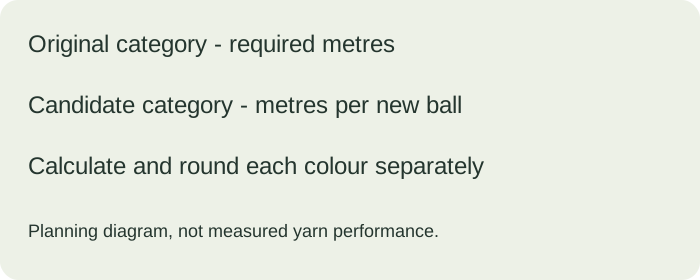
A mixed-category purchasing example
Suppose a hypothetical design allocates one Super Saver solid ball to its main colour and one Super Saver print ball to its contrast. Assume a Basic Stitch standard shade is accepted for the main and a print shade for the contrast. These are demonstration choices; no actual pattern, colour match or consumption test is claimed.
| Hypothetical role | Original reference metres | Candidate metres per ball | Whole balls with zero extra metres |
|---|---|---|---|
| Main | 333 | 170 | ceil(333 ÷ 170) = 2 |
| Contrast | 215 | 140 | ceil(215 ÷ 140) = 2 |
The order is two balls of each chosen colour. Formula: balls for one colour = ceil((required metres + explicit extra metres) ÷ candidate metres per ball). The zero extra metres in this example is a calculation setting, not a recommended allowance.
An identity error can remain hidden even if a rounded answer looks plausible. If both original balls are incorrectly treated as solids, the contrast becomes 333 m and rounds to three 140 m balls. That is an extra contrast ball caused by the wrong original input. Conversely, using the wrong candidate length may understate another order. Check the inputs before celebrating a neat total.
Keep the original allocation and its conversion visible in the saved record. This makes a later correction local to one colour instead of forcing a complete reconstruction of the shopping list. Do not spend one colour's leftover metres on another colour in the arithmetic unless changing the design is an explicit choice.
Download the per-colour purchase record. It contains HYPOTHETICAL rows and empty rows for actual labels. It is a record sheet, not an automatically recalculating spreadsheet. Add sample yarn and any project-specific allowance explicitly. A nominal-length calculation cannot guarantee completion if the accepted fabric changes actual consumption.
Paired swatch status: not tested
No Super Saver/Basic Stitch paired samples have been made for this page. Download the blank paired record. Its measured fields are empty.
Record the same maker, stitch and measuring method, the actual tools, and every adjustment. Measure before care and after complete drying, documenting the treatment used. Compare stitch and row density separately. The similar needle recommendation in the table does not erase their different reference counts. Do not enter those reference counts as measured results.
Write the project's acceptance conditions before evaluating a sample. A dimensional match does not answer every question about handle, opacity or the junction with existing fabric. Keep any rejected trial identified rather than silently presenting the last attempt as the only result.
Questions before ordering
Is Basic Stitch a proven substitute?
No. It is a candidate with published specifications; no physical equivalence has been tested here.
Can I use this for every Super Saver product?
No. Copy the exact product and label required by your pattern. This page does not establish the specifications of every related product.
Does an anti-pilling product name prove better wear?
No comparative wear test is reported here. Treat the name as product identification, not our experimental conclusion. Use the general substitution guide for the wider decision process.